Overview
TYR does not just log workouts. It turns workout logs, muscle involvement, intensity, volume, and recovery context into structured analysis. The point is not to pretend a phone can model every tissue force in your body. The point is to make training history easier to reason about.
Muscle load logic
Exercises can train more than one muscle. TYR assigns practical contribution percentages to exercises, so a set can contribute load to several muscles at once.
This can look like double counting if you add every muscle total together. That is intentional.
Example: a bench press set might be logged as 200 lb x 5 reps. TYR may assign that work across chest, front delts, and triceps because all three contributed to the movement. That does not mean the session magically had more barbell weight than the athlete lifted. It means each muscle receives its own estimated training exposure.
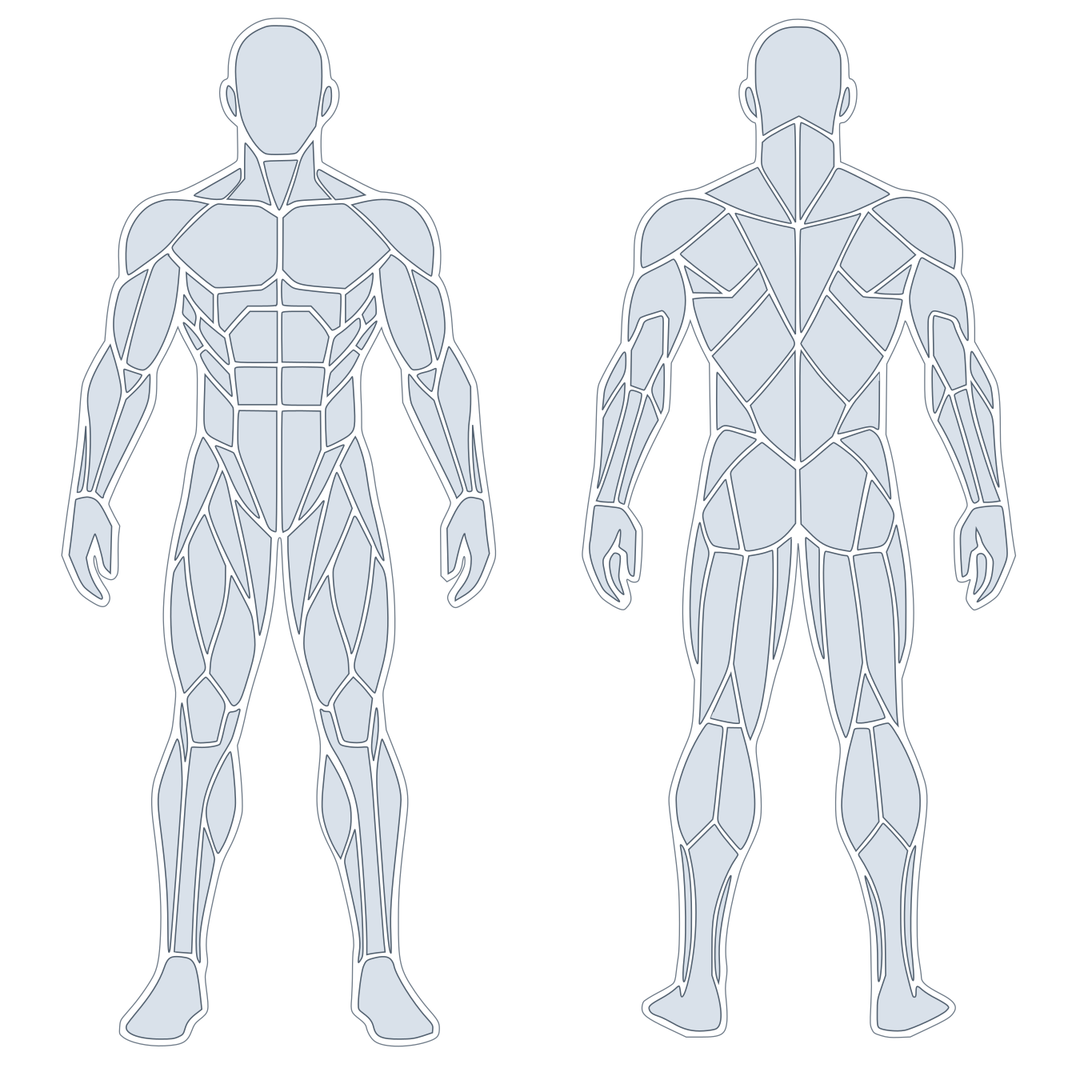
The goal is not accounting-style tonnage where every muscle must add up to the barbell total. The goal is local muscle context.
Muscle load is a directional training-context metric, not a perfect biomechanical force model.
ACWR
ACWR means Acute:Chronic Workload Ratio. Acute workload is short-term load, commonly the last week. Chronic workload is a longer baseline, commonly several weeks. TYR uses this style of comparison to surface sudden spikes or sharp drops in workload.
ACWR is not magic, and TYR does not treat it as injury prediction by itself. It is most useful beside sleep, soreness, performance, fatigue, and training history.
Example: if your normal weekly leg workload is around 10,000 lb and this week jumps to 18,000 lb, TYR should treat that as a spike worth noticing. That does not automatically mean injury risk or that the workout was wrong. It means the current week is high compared to your recent baseline, so sleep, soreness, performance, and recovery matter more.
It becomes less useful with sparse logs, new users, major exercise changes, deloads, intentionally peaking blocks, or incomplete data.
Prilepin analysis
Prilepin-style analysis looks at the relationship between intensity and useful rep ranges. It helps identify whether work at a given intensity is probably too little, reasonable, or excessive.
TYR uses it as context, not as a strict rule. It is most relevant for strength work and less relevant for bodybuilding-style accessory work, rehab work, or conditioning circuits.
Example: if you are doing heavy strength work around 85-90% intensity, a small number of clean reps can be productive. If TYR sees a lot of reps at that intensity, it can flag that the session may be unusually demanding. A few light warmup sets should not be judged the same way as hard working sets.
Workout logger intensity
For a performed set, TYR estimates the set's 1RM and compares it with the exercise's estimated working 1RM.
Intensity = estimated 1RM of the set being performed / estimated working 1RM for that exercise
This makes different rep ranges easier to compare than raw weight alone. A lighter high-rep set may be closer to maximal effort than it appears. A heavier low-rep set may be less intense if the user's working 1RM is higher.
Example: suppose TYR estimates your working 1RM on bench press at 250 lb. If you perform 200 lb x 5, the estimated 1RM from that set is roughly 225 lb. Intensity is 225 / 250 = 90%. That means TYR can compare a 5-rep set and a 10-rep set more fairly than using raw weight alone.
This is an estimate. It depends on accurate logs and is best for comparing your own training over time.
Brzycki formula
TYR uses an estimated 1RM formula where appropriate. The Brzycki formula is:
Estimated 1RM = weight x 36 / (37 - reps)
Example:
- 225 lb x 5 reps
- 225 x 36 / (37 - 5)
- 225 x 36 / 32
- Estimated 1RM ≈ 253 lb
Estimated 1RM formulas are approximations. They are most useful for comparing trends within the same user over time, and become less reliable at very high rep counts.
How to use this
TYR analysis should be treated as structured context. It is not medical advice, not a coach replacement, and not a perfect model of physiology. It is a clearer way to see what you trained, how hard it likely was, and where recovery context may matter.
Ready to turn training data into useful context?
Download TYR and start building structured health and training history.